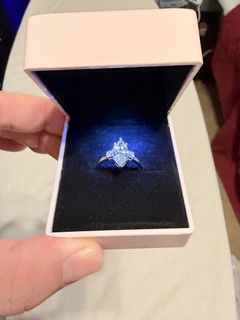
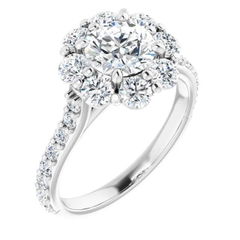
1 Carat Oval Lab-Grown Diamond Solitaire Engagement Ring in 14K Gold
A 1ct oval cut Lab-Grown Diamond, D–F color, VS+ clarity, IGI certified, four-prong set on a slim polished band in solid 14K gold. Yellow, white or rose, cut to your finger and made in 7 to 10 business days on my bench in Woodside, Queens. One oval, four prongs, nothing else asking for attention. Here is what people ask me before they choose an oval.
How big is a 1 carat oval diamond?
Roughly 8mm long by 5.7mm wide. A 1 carat round is about 6.5mm across, so the oval runs a millimeter and a half longer while giving up less than a millimeter of width. That is the whole trade, and on a hand it reads clearly — the oval covers noticeably more finger than a round of the same weight and price.
Why does an oval look bigger than a round of the same weight?
Because a round carries much of its weight in depth, below the girdle where you never see it. An oval spreads that same carat weight lengthwise instead, so more of the stone shows face-up. You are buying visible surface area rather than paying for depth nobody will ever look at. It is the most efficient shape in the catalog for people who want presence without moving up a carat.
What is the bow-tie, and does this stone have one?
Every oval has a bow-tie — a darker band across the center where facets fail to return light. On a well-cut stone you have to look for it. On a badly cut one it is the first thing you see, and it appears nowhere on a lab report, so you cannot buy against it from a spec sheet. That is why I check every oval face-up at the bench before it goes into a setting.
What color and clarity is the diamond?
D through F, the colorless range, and VS+ clarity, which is eye-clean at any angle. Color is worth paying attention to on an oval because elongated shapes concentrate body color toward the ends — a G or H that would pass unnoticed in a round can read faintly warm at the tips, especially against yellow gold. Staying in D–F keeps the stone even end to end. The IGI report ships with the ring.
Why four prongs, and where do they sit?
An oval has no corners to grip, so prong placement is a judgement rather than a rule. Set too far toward the ends and the stone looks pinched; too far to the sides and it can rock in the setting. Yours sit at the four quarter points, which holds the stone securely and leaves the length uninterrupted — the outline is the whole appeal of this shape, so nothing should break it up.
Will a wedding band sit flush against it?
Yes. The plain shank meets almost any straight band without a gap, which is the practical argument for a plain band over pavé — pavé shoulders force a contoured band or leave daylight. Since I make both to order, tell me and I will cut the pair together.
Is the gold solid, or plated?
Solid 14K throughout — not plated over brass, not gold-filled. White gold is rhodium-finished the way every white gold ring is, and I re-finish yours whenever it needs it. Nickel-free in all three colors.
How long does it take, and can it be resized?
Made to order in 7 to 10 business days, sizes 4 through 9 including halves. Resizing is complimentary within 60 days of delivery, craftsmanship carries a lifetime warranty, and you have 14 days to return it if it is not right and you have not had it engraved. It ships fully insured in our signature suede pouch with the IGI report.
What if I want a different shape or setting?
The same oval runs as a 1ct three-stone with round sides if you want more across the finger. For other shapes there is a 1ct round, a 1ct pear, a 1ct marquise and a 1ct emerald cut. Anything not on the site, I build custom — that is most of what I do.
Who makes it?
I do. One bench, one pair of hands, in a workshop in Woodside, Queens. Nothing here sits in a case waiting for a buyer — yours is cast, set and finished after you order it, cut to your finger rather than sized down to it. If something is wrong with it, you are talking to the person who made it.