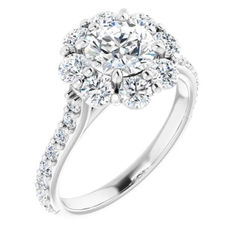
3 Carat Elongated Cushion Lab-Grown Diamond Engagement Ring in Two-Tone 14K Gold
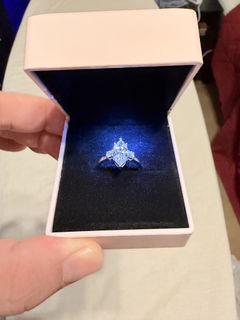
A 3ct elongated cushion Lab-Grown Diamond, D–F color, VS+ clarity, IGI certified, held in a white gold four-claw head on a yellow gold band edged in rope twist. Round Lab-Grown Diamonds run down both sides of the shank, and beneath the stone a scrolled gallery hides two more bezel-set diamonds. It's built on my bench in Woodside, Queens, and made to order in 7 to 10 business days.
How big is a 3 carat elongated cushion?
About 10 × 7.8 millimeters, with a length-to-width ratio between 1.25 and 1.35. A standard 3ct cushion is closer to square at roughly 8.5mm, so stretching the same weight north to south adds about a millimeter and a half of length you can see from across a room. On an average finger the stone covers nearly half the width and runs past the knuckle line, which makes the hand look longer and slimmer. Ask for the exact measurements before anything is cast and I'll send both the carat weight and the millimeters.
What is the difference between an elongated cushion and a regular cushion?
The outline. A regular cushion is a pillow-shaped square. An elongated cushion is the same soft-cornered stone pulled into a rectangle, which is how most cushions were cut in the 1800s, when stones were shaped to save weight from the rough. That is why this cut reads antique without trying. It faces up larger than a square cushion of the same weight, it costs noticeably less per carat than a round, and its rounded corners have no sharp point to chip.
Why a white gold head on a yellow gold band?
It's the oldest trick in fine jewelry. Jewelers in the Georgian and Edwardian eras set diamonds in white metal over a yellow gold shank so the stone stayed icy while the hand stayed warm. Yellow gold claws reflect a faint straw tone into a colorless diamond, and white gold claws don't, so the D–F stone looks white edge to edge. The yellow band then frames it with the warmth that makes the ring look like an heirloom rather than a catalog piece. If you'd rather go all-white, choose white gold or platinum and the head and band match.
What are the details under and along the band?
Look from the side. The gallery under the head carries a row of fine milgrain beads, two scrolls, and a bezel-set round diamond tucked into each scroll, like a peekaboo stone only the wearer and the people standing close will ever notice. Down both sides of the shank, a line of round Lab-Grown Diamonds is set into the profile of the band rather than on top of it, framed by rope twist on each edge. From above it looks like a clean gold band with a hint of sparkle at the edges. From the side it's a full second ring of light.
Will the rope edges and side diamonds catch on sweaters?
Not the way raised pavé does. The side diamonds sit in the wall of the band, below the top surface, so there are no claws sticking up across the top of the finger to snag knits or hair. The rope twist is solid 14K gold cast as part of the band, not a wire soldered on, so it can't lift or come loose. Over years of daily wear the high points of the rope soften slightly, which is part of the vintage look, and a refinish brings back the crisp texture.
What color and clarity is the diamond?
D through F, the colorless range, and VS+ clarity, eye-clean from every angle. Size matters here more than on a small stone. At three carats there is far more diamond for tint to show through, and elongated cushions tend to hold color at the two ends and can show a shadowed bow-tie across the middle. Staying in D–F keeps the color even end to end, and I check each stone for bow-tie before setting it. The IGI report ships with the ring.
Which wedding band sits with it?
The scrolled gallery sits low between the shoulders, so the right wedding band depends on exactly where the gallery meets the shank on your size. I make the matching band to order and cut it to seat flush against the engagement ring, with no gap under the stone. Start with the plain contour band or the pavé contour band, or send me a photo of the band you have in mind and I'll confirm the fit before anything is cast.
How long does it take, and can it be resized?
It's made to order in 7 to 10 business days, in sizes 4 through 9 including half sizes. Resizing is complimentary within 60 days of delivery, the craftsmanship carries a lifetime warranty, and you have 14 days to return it if it isn't right and hasn't been engraved. It ships fully insured in our signature suede pouch with the IGI report.
Want a different weight or style?
For a smaller, plain-band cushion, see the 2.5ct cushion cut solitaire or the 2.5ct cushion hidden halo pavé band. Browse every shape in cushion cut engagement rings and vintage inspired engagement rings, or read the bench jeweler's guide to antique cushion cuts. Anything not on the site, I build custom.
Who makes it?
I do, at one bench with one pair of hands, in a workshop in Woodside, Queens. Nothing here sits in a case waiting for a buyer. Each ring is cast, set and finished after it's ordered.