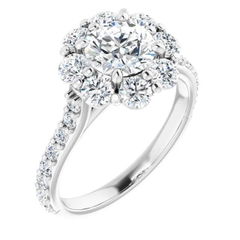
2 Carat Oval Hidden Halo Lab-Grown Diamond Engagement Ring
A 2ct oval cut Lab-Grown Diamond, D–F color, VS+ clarity, IGI certified, set above a hidden halo of pavé diamonds on a slim tapered band in solid 14K gold. Made to order in 7 to 10 business days on my bench in Woodside, Queens.
What is a hidden halo?
A ring of small diamonds set around the outside of the basket, below the center stone, facing outward rather than up. From directly above you do not see it — the ring reads as a clean solitaire. From the side, and every time her hand moves, a band of light appears underneath the stone.
Why is the hidden halo shaped to the stone?
Because an oval basket is not round. The halo is built as an elongated ring rather than a circle, with the accent stones graded closer together at the tight ends and further apart along the flanks so the light reads evenly all the way round. Stretch a round halo template over a 2ct oval and it bunches at the points and gaps along the sides — the most common flaw in a mass-produced oval hidden halo, and more visible the larger the stone gets.
Does it make the diamond look bigger?
No. A traditional halo surrounds the stone face-up and enlarges the outline. A hidden halo sits underneath, so face-up you see exactly what a 2ct oval gives you — about 10mm by 7mm. What it adds is depth in the side profile. The oval is already doing the size work: 10mm of length reads well beyond two carats on the hand.
How many diamonds are in the halo?
Twenty to twenty-four round accents depending on basket size, each matched to the center for color so the halo does not read warm against a colorless stone. Bead-set by hand rather than channel-set, so each sits individually and catches light on its own.
Does it sit higher than a solitaire?
Slightly. The halo needs room beneath the stone, so the head sits a touch taller than the 2ct oval solitaire. On most hands the difference is not noticeable in wear. If she works with her hands or has asked for a low profile, the plain solitaire is the better ring.
What color and clarity is the center diamond?
D through F, the colorless range, and VS+ clarity, eye-clean at any angle. Color matters more on an oval than a round because elongated cuts gather body color at the ends, and again here because the halo sits directly against the center. A warm halo under a colorless stone is the most common tell of a cheaply built hidden halo. The IGI report for the center stone ships with the ring.
What about the bow-tie?
Every oval has one across its center and it appears on no lab report. At two carats a bad one is obvious, and a hidden halo does nothing to disguise it — it sits underneath, not across the face. I check each oval face-up at the bench rather than buying to a specification sheet.
Which wedding band fits it?
A contoured band. There is a second gallery under the head — an extra rail of gold beneath the basket that carries the stone's weight and stops the prongs flexing over years of wear — and the hidden halo sits on top of it. A straight band meets the gallery rather than the shank and stands off. A curved band dips at the center, clears both and nests flush. I make both to order — or start with the plain contour band or the pavé contour.
How long does it take, and can it be resized?
Made to order in 7 to 10 business days, sizes 4 through 9 including halves. Resizing is complimentary within 60 days of delivery, craftsmanship carries a lifetime warranty, and you have 14 days to return it if it is not right and you have not had it engraved. It ships fully insured in our signature suede pouch with the IGI report.
Want a different weight or shape?
The same hidden halo runs at 1.5ct and 2.5ct, and in every shape I cut. To compare shapes, start with the diamond shape guide. Anything not on the site, I build custom.
Who makes it?
I do. One bench, one pair of hands, in a workshop in Woodside, Queens. Nothing here sits in a case waiting for a buyer — yours is cast, set and finished after you order it.