2 Carat Marquise Claw Prong Engagement Ring
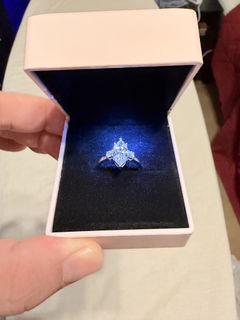
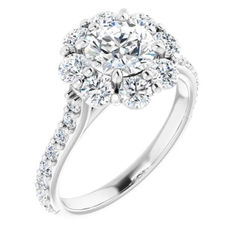
Six sharp claw prongs hold a 2ct marquise Lab-Grown Diamond so little metal touches the stone that it looks suspended above the finger. A tight trio of round brilliants sits against each side, 2.48ctw in all, turning a 13mm sliver of light into a four-pointed star roughly 16mm across. D–F color, VS+ clarity, IGI certified center, solid 14K gold, claw-set by hand on my bench in Woodside, Queens.
What is a claw prong setting?
A claw prong is a prong that tapers from a thick base to a fine pointed tip, like a talon, instead of ending in the round bead most engagement rings use. The point lands on the very edge of the diamond, so it holds the stone securely while covering almost none of its face. On this ring every claw is hand-shaped and polished after the stone is set, which is why the tips look crisp in the photos rather than lumpy. Jewelers also call them talon prongs or eagle-claw prongs; the meaning is the same.
Why claw prongs are the right setting for a marquise
A marquise is defined by its outline: two long curves meeting at two sharp points. Round-bead prongs blunt that outline, because each bead is wider than the point it sits on. Claw prongs taper to the same fine point as the stone, so the setting follows the shape instead of fighting it. Less metal over the diamond also means more light enters the top of the stone, and on a 2ct marquise with a 13mm face that is a visible difference in sparkle. If the reason someone wants a marquise is that dramatic, pointed silhouette, claws are how to keep it.
Do claw prongs protect the points of a marquise?
Yes, and that is their most important job here. The two tips are the most fragile part of every marquise, and a 13mm stone puts more leverage on them than a small one. On this ring one claw is seated directly over each point, wrapping the tip in gold so the sharpest edges of the diamond never meet a countertop, a doorframe or a car door unprotected. Two more claws hold each long side, six in total. For anyone whose work is hard on the hands, tell me before I start and I will build full V-prongs over both tips instead, at no extra charge.
Claw prongs or round prongs: which should you choose?
Round prongs are the safe, classic default, and they are what holds the center on the 2ct marquise three-stone. They are a touch more forgiving day to day. Claw prongs are the sharper, more modern look: thinner metal, more visible diamond, a cleaner line. The tradeoff is upkeep, because fine tips wear faster than round beads, so a claw-set ring should see a jeweler for a prong check once a year. If maximum low-maintenance matters most, choose round. If the look of the stone matters most, choose claws.
Do claw prongs snag on clothes and hair?
Badly made ones do. A claw left with a raw, upturned tip will catch a sweater on the first day. I file every claw so its point folds down flat against the diamond, then polish it smooth, so there is no edge standing proud of the stone to grab a knit or a strand of hair. The cluster stones use shared prongs that sit low and tight against the center for the same reason. Run a finger across the head and it should feel like the stone, not like the metal.
What exactly is in a 2.48ctw marquise claw prong ring?
The center is a 2.00ct marquise brilliant Lab-Grown Diamond, about 13mm long by 6.5mm wide, D–F color and VS+ clarity, shipped with its IGI report. Six round brilliant Lab-Grown Diamonds of about 0.08ct each, close to 2.7mm across, sit in two triangular clusters of three, one along each long side of the center, for 0.48ct of side stones and 2.48ctw total: a seven-stone engagement ring in the classic cluster arrangement. The side stones meet the same D–F and VS+ standard as the center. It is cast in solid 14K yellow, white or rose gold, in US sizes 4 through 9 including halves.
How big does a 2 carat claw-set marquise look on the hand?
Bigger than any other 2ct shape. A 2ct round measures about 8.1mm across; a 2ct marquise covers 13mm of finger at the same weight, and because claw prongs add almost no metal around the outline, nearly all of that length reads as diamond. The two clusters widen the head to about 16mm. On a long hand or a size 6 and up, it looks balanced and deliberate. On a petite hand, sizes 4 to 5, it will cover nearly the full width of the finger, and that should be exactly the statement someone wants before choosing it.
Cluster sides or a plain claw-set solitaire?
The 2ct marquise solitaire is the purest line: all length, nothing beside it. The clusters trade a little of that purity for presence. They fill the empty gold beside the center, throw light when the hand turns, and give a long, narrow stone some shoulders, so it never looks thin from the side. The look sits closer to a mid-century estate cluster ring than a minimalist solitaire, without the guesswork of an old stone. Choose the solitaire for restraint; choose the cluster if a single stone feels too quiet.
Why D–F color and VS+ clarity matter more with claw prongs
Claw prongs show more of the diamond than any other prong style, so they hide nothing. Elongated shapes gather body color at their tips, and a warmer grade that would disappear behind round beads shows up as yellow at both exposed points of a claw-set marquise, especially next to six bright white rounds. Holding the center and every side stone to D–F keeps the whole head one clean color. Every marquise also carries a bow-tie, a darker band across the middle that no lab report records, so I inspect each center face-up at the bench before it goes near a setting, and at two carats I reject more stones than I keep.
Which wedding band fits a marquise claw prong ring?
A contoured band. The claws over the marquise points and the outer cluster stones sit low at the sides, and a straight band leaves a visible gap against them. A curved band clears the head and nests against it cleanly. Because I make both to order, ask and I will cut them as a matched pair, or start from the plain contour band or the pavé contour band.
More 2 carat marquise engagement rings
The 2ct marquise solitaire drops the side stones entirely. The 2ct marquise three-stone keeps one round per side in round prongs. The 2ct marquise hidden halo hides its sparkle under the center instead of beside it. Browse every marquise engagement ring in the catalog.
How long does it take, and what if it does not fit?
Every ring is made to order in 7 to 10 business days, cast, claw-set and finished after the order is placed rather than pulled from a drawer. Resizing is complimentary within 60 days of delivery, craftsmanship carries a lifetime warranty, and there is a 14-day return window on any piece that has not been engraved or personalized. It ships fully insured in our signature pouch with the IGI report.
Who makes it?
I do. One bench, one pair of hands, in a workshop in Woodside, Queens. I learned this trade in a family wedding band factory in Long Island City, and I shape and file every claw on this ring myself. Real 14K gold, a certified 2ct Lab-Grown Diamond, and handwork you can see at the tip of every prong, at a price well under what traditional retail asks for the same weight.