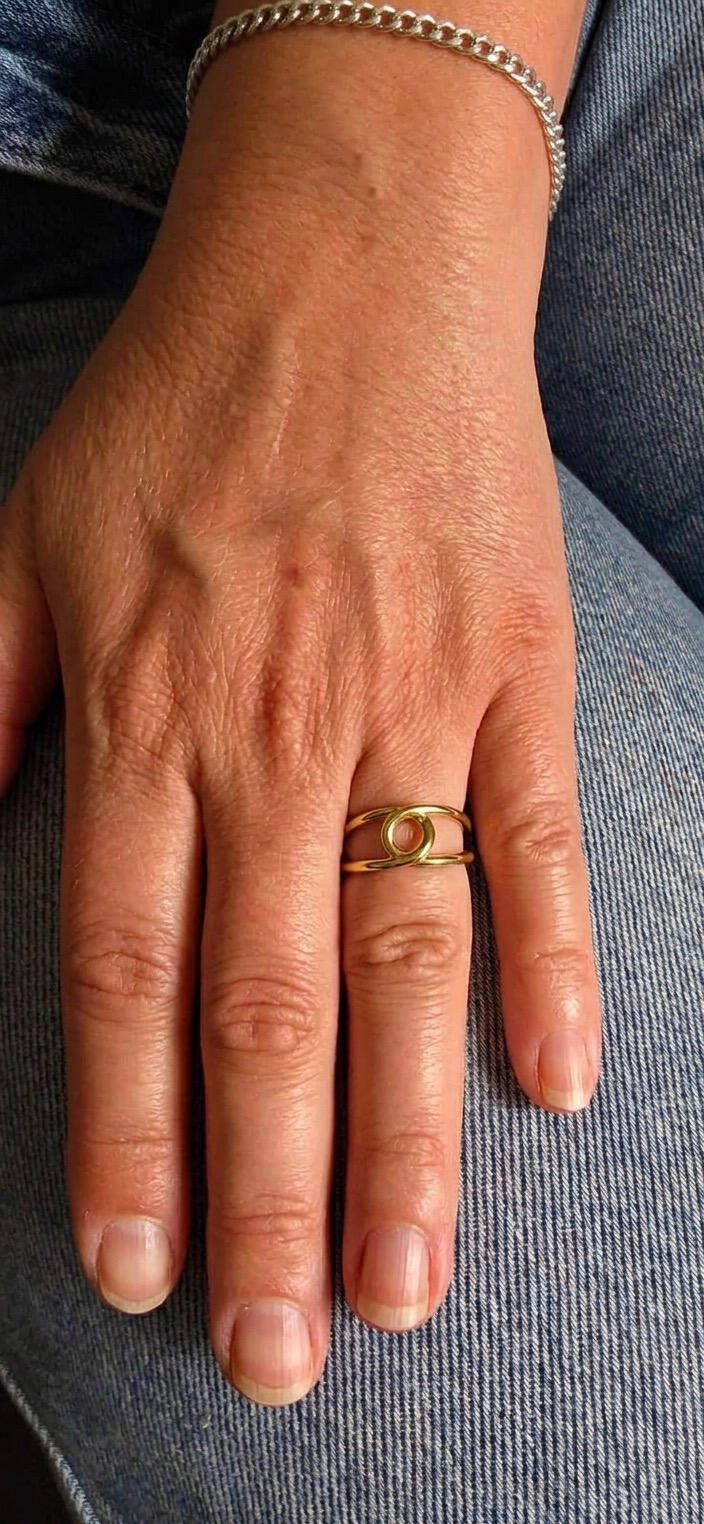
Once you have settled on 4mm, the hard part is not over. Four millimeters is the most popular width in men's wedding bands and the most common crossover width for women, which means it is also the width where the most choices exist. Ten of them are made at our bench in Woodside, Queens, and this is how to tell them apart.
If you are still deciding on width, start with our guide to 4mm vs 5mm vs 6mm wedding bands and come back. If you already know 4mm is right, read on.
Answer the Finish Question First
Before profile, before texture, before anything: decide whether you want a polished ring or a satin one. It is the single decision that most affects how the band looks in five years, and almost nobody thinks about it in the shop.
A polished band is the brightest surface gold takes. It is also the most honest about wear. Every scratch it picks up shows against the mirror, and on a flat face — one uninterrupted plane — they show most of all. Most men come to like this. The marks become a record of the years, and a few minutes at the bench restores the shine whenever you want it back.
A satin band is brushed by hand in one direction, leaving a fine linear grain that diffuses light instead of returning it. Scratches settle into that grain rather than standing out against a mirror, so the ring looks much the same in year ten as it did in year one. If you work with your hands, or if you simply never want to think about the ring again, satin is the answer.


The same band, the same width, the same metal. Polished on the left, satin on the right. That is the whole decision, and everything below is a variation on it.
The Plain Bands
Four of the ten have no ornament at all. They differ only in profile — how the face of the band is shaped — and in finish.
Flat
A flat band sits level from edge to edge with the sides dropping straight, so the ring reads as a clean band of metal rather than a curve. Because the full 4mm faces outward, a flat band looks wider on the hand than a domed band of the same measurement. That is the reason to choose it: presence without adding millimeters. The flat interior also takes engraving better than any other profile, which matters if a date or a name is going inside.
We make it two ways. The 4mm Flat Polished Wedding Band at $915 is the plainest ring we make, and that is the entire point — nothing to date it, nothing to tire of. The 4mm Flat Satin Wedding Band at $920 is the same geometry with the scratch problem solved.

Dome
The dome is the oldest wedding band shape there is, and it survives because it works. The exterior curves gently from edge to edge so there is no hard corner pressing against the fingers on either side. It is the safest choice for a man who has never worn a ring, and the one most likely to be forgotten within a week of putting it on.
The Triborough 4mm Dome Wedding Band at $895 is the polished version and our entry point at this width. The 4mm Satin Dome Wedding Band at $920 is the brushed one, and the version most men who work with their hands end up choosing.

The Shaped Bands
Three bands take the plain profile and cut it. Two are bevels and one is a knife-edge, and they are confused with one another more than any other group we make, so it is worth being precise about the difference.
Beveled Edge
A bevel chamfers the two outer edges and leaves the center face flat, so the ring keeps a broad plateau across the top with two angled facets running along either side. You get softened corners and a little extra play of light without losing the flat surface. It is the most conservative way to add structure to a plain band.
The 4mm Beveled Edge Wedding Band at $929 is the polished version — brighter, dressier, and the more traditional read. The 4mm Satin Beveled Edge Wedding Band at $940 takes the same profile and brushes the face instead. That matters more here than on most profiles: the flat plateau across the top is exactly the kind of uninterrupted surface where scratches show worst, and satin removes the problem entirely.

Knife-Edge
A knife-edge removes that plateau entirely. The two faces angle up from both rims and meet at a defined center line, which means one face is almost always brighter than the other as your hand moves. It gives a plain gold band a spine. The ridge is finished slightly rounded rather than literally sharp, so it wears comfortably against a neighboring finger. The 4mm Knife-Edge Wedding Band is $945.

Choose a bevel if you want a flat surface with softened corners. Choose the knife-edge if you want the band itself to have an edge.
The Textured Bands
Two bands carry a worked surface rather than a smooth one. Texture is the most practical choice at this width, because a broken surface hides wear better than any flat plane can.
Hammered
The facets are struck one at a time by hand, so no two bands catch light the same way. We finish it both ways, and the two versions behave very differently.
The 4mm Hammered Wedding Band in satin finish at $965 takes the shine down to a soft matte glow. Between the texture and the brushed surface, it is the most forgiving ring on this page — the one you can wear through a decade of work and barely notice the difference.

The 4mm Polished Hammered Wedding Band at $965 does the opposite. A flat polished band returns light as one sheet; a polished hammer breaks it into a dozen, each facet sitting at its own angle and catching independently. It is the most alive surface we make without setting a single stone.

The Detailed Band
One band has ornament proper. The 4mm Milgrain Wedding Band at $995 carries a continuous row of miniature beads worked along each rim, framing a polished flat center. The technique comes from Edwardian and Art Deco jewelry, where it softened the transition between metal and stone; on a plain band it works as a border, catching light at a finer scale than the face beside it. From across a room the band reads as a clean line of gold. Up close, the detail appears.

It is also the band that crosses over most easily. At 4mm with milgrain edges it reads equally well as a women's band, which makes it the simplest starting point if you are looking for a matched pair.
Choosing Your Metal
Every band on this page is available in solid 14K yellow, white or rose gold — never plated, never gold-filled. The metal changes the design more than most people expect.
Yellow gold is the traditional choice and the warmest, and it is where hand-worked textures like hammering and milgrain read most clearly. White gold is cooler and more graphic; it is the strongest choice for the knife-edge and the polished hammer, where the whole effect depends on contrast between lit and unlit faces. Rose gold sits between the two and suits the vintage character of milgrain particularly well.
Since every band is cast in the metal you choose, it is worth a moment's thought before ordering.
Fit, and What Comfort-Fit Actually Means
All ten bands are comfort-fit, which describes the inside of the ring rather than the outside. The interior is gently domed instead of flat, so only the center of the band contacts your finger. It clears the knuckle without dragging and sits without a hard edge pressing in over a long day. Flat bands in particular have a reputation for feeling rigid, and that reputation comes almost entirely from rings with flat interiors.
Made to Order in Queens
We hold no inventory by design. When your order arrives, your band is cast in your size and your metal, then shaped, textured and finished by hand at our bench in Woodside. Production runs two to three weeks before it ships free and fully insured. Every piece carries a lifetime warranty on workmanship and free resizing, and non-engraved bands can be returned within fourteen days.
You can see all ten together on the 4mm wedding bands collection page.
A Width or Finish We Don't List
If you want one of these profiles at a different width, a satin center where we have shown polished, or a slimmer matching band for a partner, write to me. I cut these one at a time at the bench, which means the width is a decision rather than a limitation. Call or text 929-806-1502, or email info@blackpearlofqueens.com.
Dimitrios Koukoulis is the founder and sole craftsman of Black Pearl of Queens, working from a small studio in Woodside, Queens.